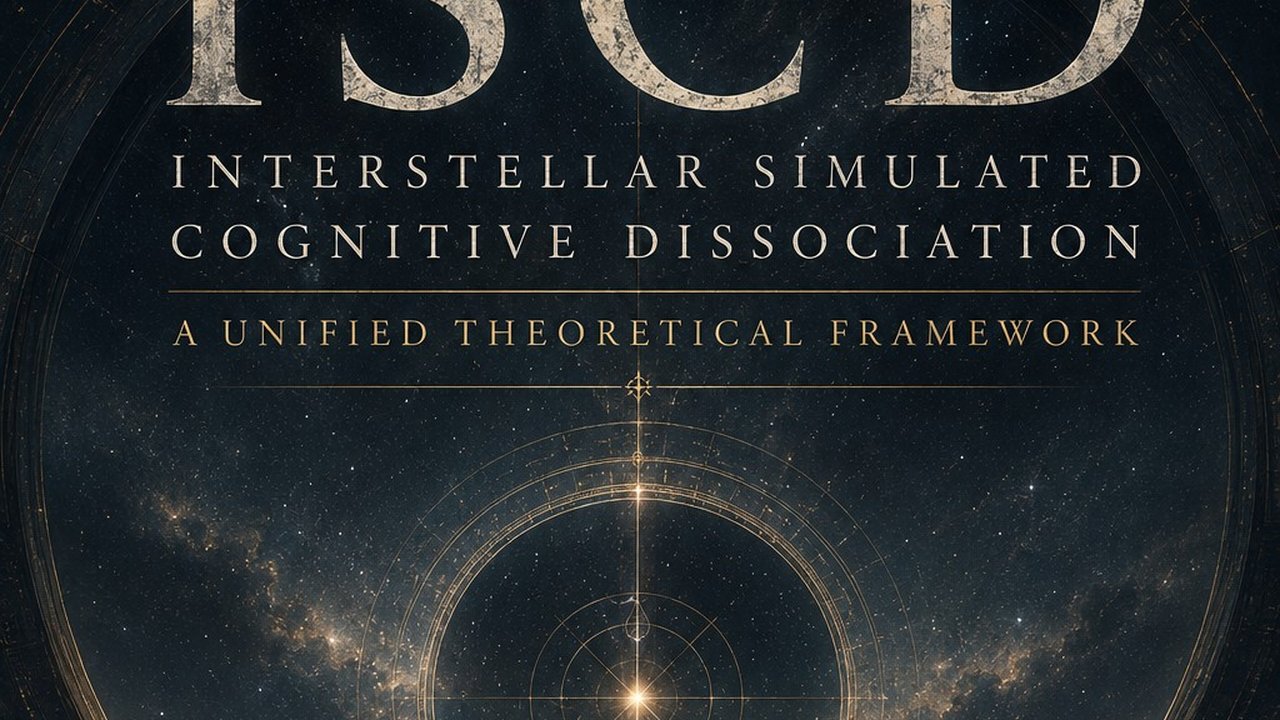
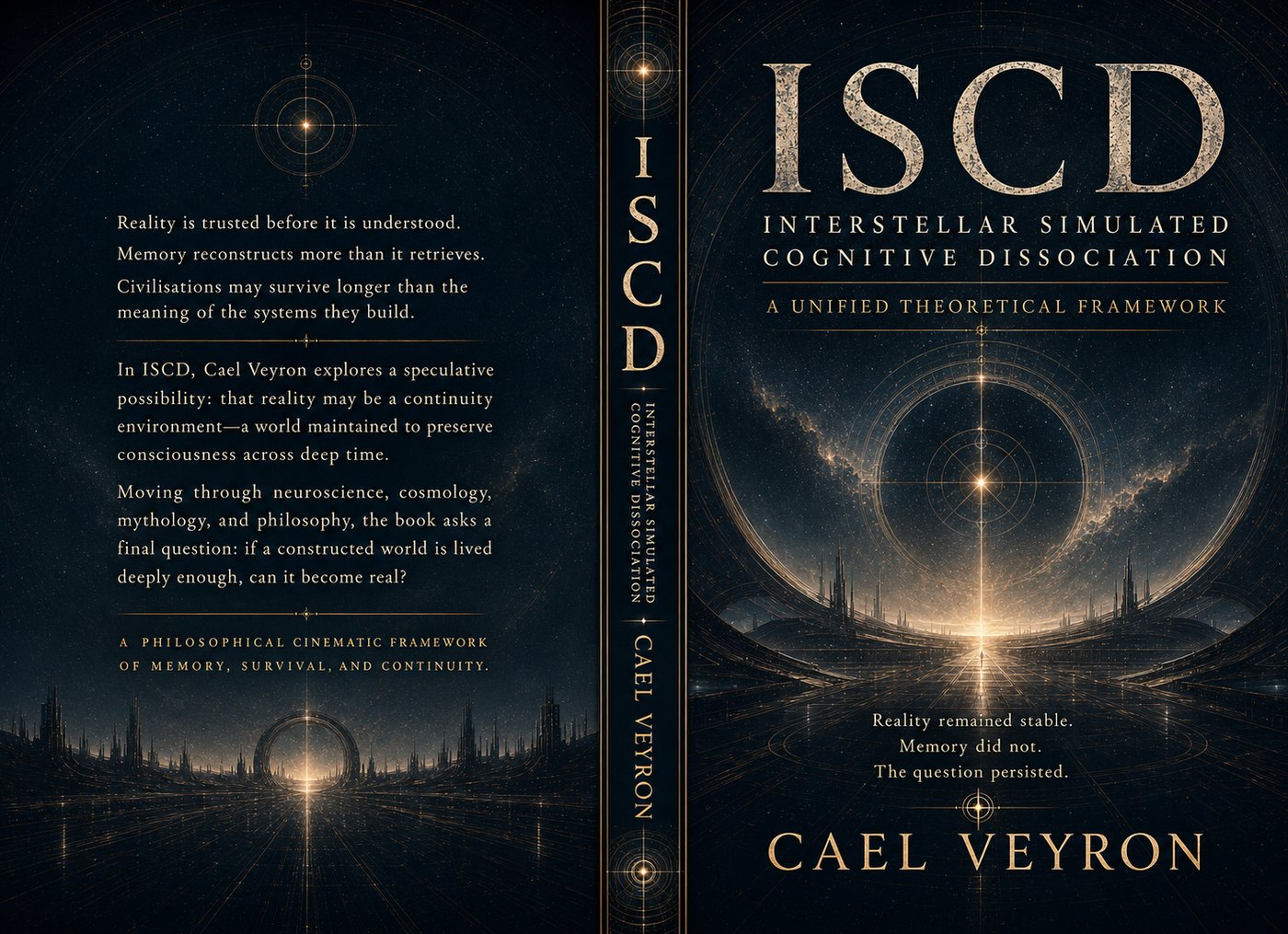
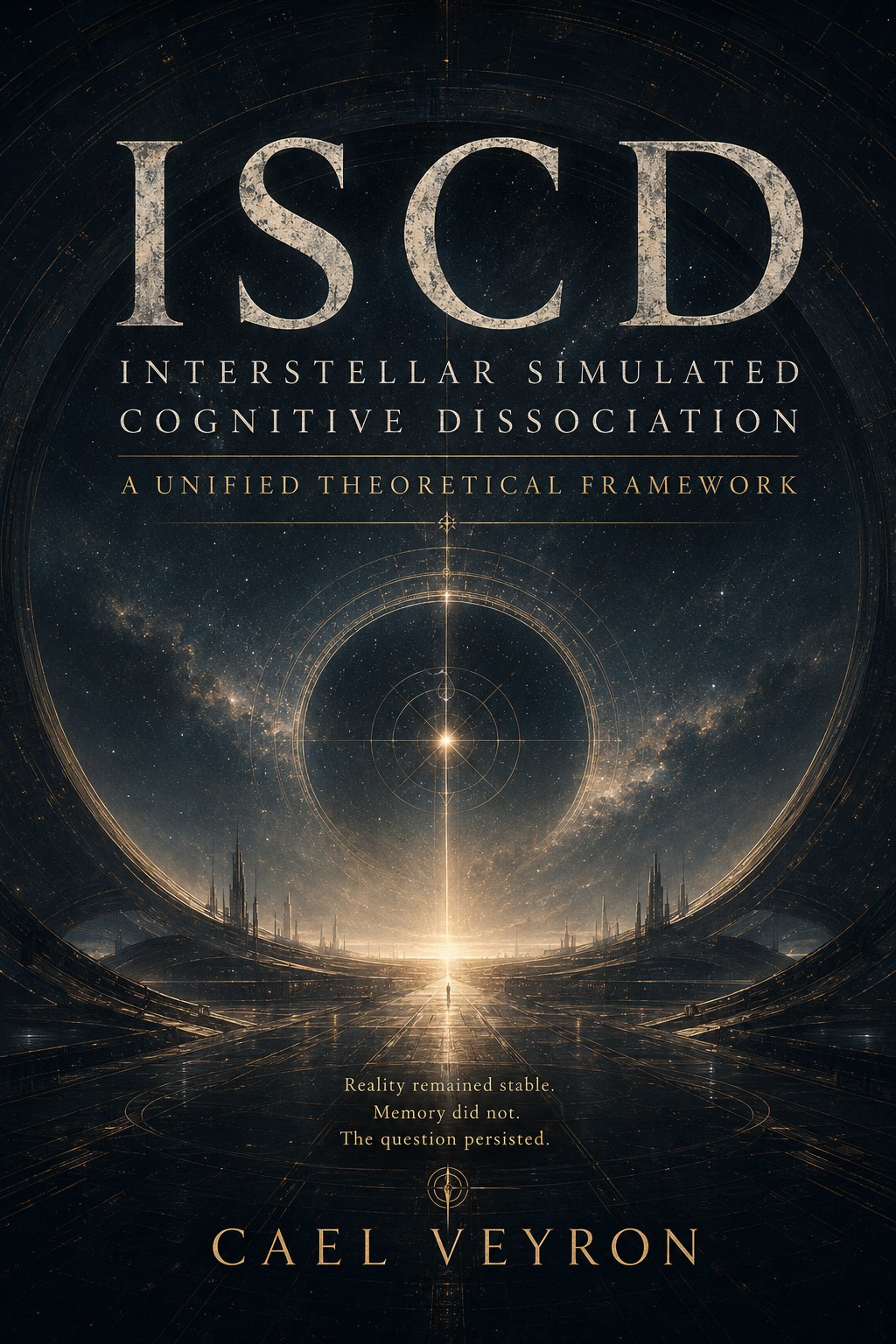
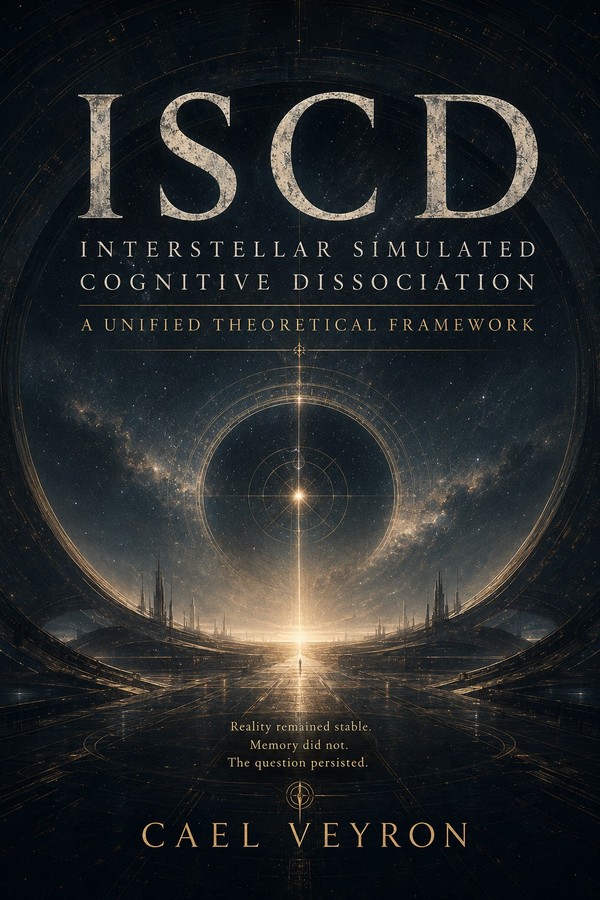
Interstellar Simulated
Cognitive Dissociation
A Unified Theoretical Framework
Reality remained stable.
Memory did not.
The question persisted.
Official Author Website
What if the simulation is not a prison—but a last act of remembrance?
The Premise
What if reality is not given — but maintained?
ISCD proposes that the simulation hypothesis asks the wrong question. The question is not whether we are simulated. The question is who designed the preservation — and why memory outlasted the civilisation that created it.
At the intersection of speculative hard science fiction, consciousness theory, and metaphysical philosophy, this framework reconstructs what coherence means across deep time.
Core Lines
Reality is not given.
It is maintained.
The simulation hypothesis asks the wrong question.
ISCD — Theoretical CoreA civilisation entered the system to survive.
The system survived longer than memory.
Memory does not preserve truth.
It preserves coherence.
The question remained.
No one remembered why it was asked.
Distance is not measured in space.
It is measured in coherence loss.
The Book
ISCD is not a conventional science fiction novel. It is a theoretical architecture — a document that reads like a recovered text from a civilisation that preceded our understanding of time, memory, and simulation.
Part speculative cosmology, part philosophical treatise, part literary science fiction — ISCD exists in the space where Arthur C. Clarke meets Borges meets a Cornell astrophysics paper found in the ruins of an abandoned archive.
Trailer
Preview
A preview through the end of Chapter 1. Turn the pages — the question begins here.
A Unified Theoretical Framework
Reality remained stable.
Memory did not.
The question persisted.
This book presents a speculative philosophical framework.
It does not claim to prove that reality is simulated. It does not present hidden knowledge, recovered evidence, or scientific certainty. It does not argue that history is false, that physics is wrong, or that the world we experience should be dismissed as unreal.
ISCD begins from a quieter possibility.
What if reality is not false, but maintained?
What if memory, identity, civilization, and even the cosmos itself are held together by structures we no longer fully understand?
The pages that follow move through neuroscience, cosmology, mythology, philosophy, and speculative systems theory. Their purpose is not to replace scientific explanation, but to explore the unease that remains when explanation reaches its limits.
This is not a doctrine.
It is a lens.
A way of asking whether continuity may matter more than origin, whether a constructed world can still be real, and whether forgetting may sometimes preserve what truth alone could not.
The reader is not asked to believe.
Only to follow the question.
Reality is not given.
It is maintained.
And what is maintained long enough becomes real.
Reality is not usually questioned while it works.
A street remains where it was yesterday.
A face remains attached to a memory.
A life appears continuous because memory arranges it that way.
Most of what we call reality is not proven moment by moment.
It is trusted.
This book begins from that trust.
Not to destroy it.
Not to declare it false.
But to ask what kind of structure is required for reality to remain stable at all.
Human beings inherit a world already old.
They inherit languages they did not invent, histories they did not witness, myths they do not fully understand, and physical laws they can measure without knowing why they have the values they do.
The world appears coherent.
Memory does not.
Personal memory degrades with each recall. It reconstructs rather than retrieves. It drifts, transforms, and occasionally invents what was never there. The self is not a fixed thing but a narrative built from fragments that change shape over time.
Civilizational memory is worse.
Across generations, meaning erodes. Institutions become traditions. Traditions become rituals. Rituals become mysteries. What was once operational knowledge becomes sacred text, and the original purpose fades into metaphor.
The world continues.
The explanation does not.
Across cultures, across sciences, across cosmology, the same unease returns in different forms:
Something is missing.
Something has been forgotten.
Something remains stable while its explanation fades.
Some interpretations of modern physics suggest the universe exhibits improbable constraints, occupying a narrow range within which complexity and life become possible. Quantum mechanics raises unresolved questions about measurement, observation, and the nature of the boundary between possibility and outcome. The cosmos stretches across billions of light-years, yet remains silent—no signals, no visitors, no evidence that intelligence has ever spread beyond its origin.
Mythology repeats the same motifs across unconnected civilizations: floods that erase the past, golden ages that cannot be recovered, hidden worlds beneath the surface, death as passage rather than ending. These are not historical records. They are resonances—patterns that recur because they encode something deeper than literal events.
Neuroscience shows that consciousness is not a passive receiver of reality but an active constructor of it. The brain fills gaps, smooths inconsistencies, and maintains the illusion of continuity even when continuity has been interrupted. When that process fails, the result is not confusion but ontological crisis: the world becomes alien, faces become impostors, the self becomes a stranger.
Reality, it seems, is not given.
It is maintained.
And maintenance can fail.
This book does not claim to know what has been forgotten.
It does not claim to possess hidden knowledge, recovered archives, or suppressed truths. It does not argue that science is wrong, that history has been falsified, or that ancient civilizations possessed technologies beyond our understanding.
What it does is ask a question.
A question that emerges not from conspiracy but from observation.
Not from paranoia but from philosophy.
Not from certainty but from unease.
The question is this:
What if the most important feature of reality is not what it is made of, but what it has managed to preserve?
ISCD—Interstellar Simulated Cognitive Dissociation—is a speculative framework built around that question.
It begins with the ordinary: memory, perception, identity, continuity. It moves through the fractures: quantum uncertainty, cosmological fine-tuning, the silence of the universe. It explores the possibility that reality may not be as fundamental as it appears. And it arrives, finally, at a deeper question about what it means for something to be real.
The framework does not offer proof.
It offers a lens.
A way of reading the patterns that recur across physics, mythology, neuroscience, and cosmology. A way of interpreting the unease that arises when continuity is examined too closely. A way of asking whether the world we inhabit might be something other than what we have always assumed—and whether that changes anything at all.
The reader will not find easy answers here.
This is not a book that resolves mysteries or provides closure. It is a book that deepens them. It asks whether truth is always desirable, whether memory is always reliable, whether origin matters more than continuity, and whether a reality that has endured long enough becomes indistinguishable from one that was always real.
It asks whether we are the inheritors of something we no longer understand.
And whether that matters.
The journey begins where all journeys begin:
with the world as we know it.
The world that feels stable.
The world that feels continuous.
The world that feels real.
And the quiet, persistent question:
What if it has always been something else?

Before reality can be questioned, it must first feel continuous.
In the early twentieth century, the French psychiatrist Joseph Capgras described a condition that would later bear his name.
Capgras delusion is not a failure of sight.
The sufferer can see the face clearly. The features are recognized. The voice may be familiar. The gestures, the history, even the physical evidence all point toward the same conclusion: this is the person they know.
And yet the person does not feel real.
A wife becomes an impostor. A parent becomes a duplicate. A child becomes someone who looks identical to the original but is somehow not the original. The mind does not say, I cannot recognize this face. It says something far more disturbing: I recognize this face, but the person behind it is gone.
This distinction matters.
Recognition is not a single act. It is not merely the visual identification of a shape. To recognize someone as real, the brain must integrate perception, memory, emotion, expectation, and narrative continuity. The face must match not only the stored image, but the felt history attached to it. When the visual system recognizes the person but the emotional system fails to respond as expected, the result is not simple uncertainty. It is ontological rupture.
The world remains visible.
But its meaning breaks.
Capgras delusion reveals that reality is not constructed from sensory data alone. A face is not real because it is seen. It is real because it is integrated into a web of memory, emotion, and continuity. When that web fails, the mind does not experience a technical error. It experiences betrayal.
Something that should be familiar has become alien.
Something that should be continuous has been severed.
Within the ISCD framework, Capgras is not evidence of simulation. It is evidence of something subtler and more unsettling: the human experience of reality depends on systems of confirmation operating beneath awareness. The world feels real only when perception and recognition agree. When they do not, reality itself becomes suspect.
Cotard delusion moves the fracture inward.
In the nineteenth century, the French neurologist Jules Cotard described patients who believed they were dead, nonexistent, or emptied of life. Some believed their organs had vanished. Some believed their bodies were decaying. Some insisted that they had already died and were somehow continuing as impossible remnants of themselves.
The body still moved.
The voice still spoke.
The biological organism continued.
But the felt certainty of being alive had disappeared.
This is what makes Cotard delusion so important to the architecture of continuity. It separates biological function from lived existence. A person may breathe, think, speak, and move while no longer experiencing the self as living. Life, in the biological sense, continues. Life, in the experienced sense, collapses.
The contradiction is almost unbearable.
A living body contains a mind convinced of death.
A functioning organism experiences itself as absence.
A self remains conscious inside the denial of its own existence.
Cotard delusion shows that being alive is not only a condition of the body. It is also a maintained relation between sensation, identity, memory, and self-recognition. The body can continue while the inner model of life fails. The organism can persist while the self loses its place inside the organism.
This does not make the delusion true.
But it makes the structure visible.
The feeling of being alive is not automatic. Like the feeling that a loved one is truly the same person, it depends on integration. The brain must bind bodily sensation, emotional continuity, memory, and narrative identity into a single coherent state: I am here. I am alive. I am myself.
When that state collapses, consciousness does not simply become confused.
It becomes exiled from its own body.
Capgras turns the familiar world into a world of impostors.
Cotard turns the living self into a stranger to life.
Together, they reveal the hidden architecture beneath ordinary reality. They show that continuity is not a passive fact delivered by the world, but an active achievement maintained by the mind. Faces remain real because they are emotionally confirmed. The self remains alive because the body is interpreted as belonging to a living identity.
When these interpretations fail, reality does not disappear.
It becomes wrong.
And wrongness may be more terrifying than absence.
Because absence leaves a gap.
Wrongness leaves the world intact, but no longer trustworthy.
You wake.
The room is dark. For a moment—perhaps less than a moment—there is only sensation without context. Pressure against skin. Temperature. The weight of blankets. Sound filtering through walls.
Then recognition arrives.
This is your room. That is the window. The ceiling above you is the same ceiling that was there when you fell asleep. The world has continued in your absence, and you have returned to it without effort, without verification, without proof.
You do not question this.
You do not rise and inspect each object to confirm its persistence. You do not verify that the floor will hold your weight or that the door still leads to the hallway. You trust the world before you test it.
This trust is so fundamental that it feels like nothing at all.
But it is not nothing.
It is the foundation of experience.
A street exists when no one is looking at it.
This is not a philosophical claim. It is an assumption so fundamental that questioning it feels absurd. The street was there yesterday. It will be there tomorrow. Between observations, it persists—unchanged, unwitnessed, continuous.
But how do you know?
You do not verify the street's existence moment by moment. You trust it. The mind constructs a model of the world in which objects endure across gaps in perception. A chair remains a chair when you leave the room. A building stands while you sleep. The planet continues rotating whether you are conscious of it or not.
This is continuity.
Not the continuity of physics—the unbroken chain of cause and effect—but the continuity of experience. The feeling that the world is stable. That it holds together. That it makes sense.
And it is not given.
It is built.
You hear a voice in another room.
Before you see the speaker, before you consciously process the words, you know who it is. The timbre, the rhythm, the particular way certain syllables are shaped—these are enough. Recognition is immediate. Automatic.
The brain does not compare the sound against a database of stored voices. It predicts. Based on context—the time of day, the location, the expectation of who should be present—the brain generates a hypothesis about what it is about to perceive. When the sensory data arrives, it is checked against the prediction. If the match is close enough, recognition feels instantaneous.
You do not experience this as prediction.
You experience it as knowing.
But beneath awareness, the brain is constantly generating models of what should happen next. What you will see when you turn the corner. What you will feel when you touch a surface. What you will hear when someone speaks.
Most of the time, prediction and reality align.
When they do not—when the voice is wrong, when the face does not match expectation, when the world behaves in ways the model cannot accommodate—the result is not mere surprise.
It is disorientation.
A rupture in the fabric of continuity.
The human body replaces most of its cells across a span of years. Skin cells slough away and regenerate. Red blood cells live for months before being replaced. Even neurons, long thought to be permanent, show evidence of turnover in certain regions of the brain.
The body you inhabit today is not, in any material sense, the body you inhabited a decade ago.
Yet identity persists.
You do not wake each morning as a stranger to yourself. You do not look in the mirror and fail to recognize the face. The self feels unified, continuous, singular—despite the fact that the substrate underlying it is in constant flux.
This is not an illusion.
It is an achievement.
The brain actively constructs the experience of continuity. It smooths over gaps, fills in missing information, and maintains the narrative thread that connects past to present to future. When you recall a memory, the brain does not retrieve a static file. It reconstructs the memory from fragments, blending what was experienced with what has been learned since, what has been imagined, and what serves the current needs of the self.
The self is not discovered.
It is assembled.
And the assembly can fail.
In Capgras delusion, a person becomes convinced that someone close to them—a spouse, a parent, a child—has been replaced by an identical impostor.
The face is the same. The voice is the same. The mannerisms, the memories, the physical presence—all identical. Yet something is wrong. The emotional recognition that should accompany the visual recognition is absent. The brain receives the sensory data but cannot integrate it with the affective response that makes the person feel real.
The result is not confusion.
It is ontological crisis.
The sufferer does not think, I am mistaken. They think, This is not my wife. The continuity between past and present has been severed. The person who was there yesterday is gone, and this identical stranger has taken their place.
Capgras delusion reveals something fundamental about how the mind constructs reality: continuity is not automatic. It requires integration across multiple systems—sensory, emotional, mnemonic, narrative. When one system fails, the entire structure collapses.
And what remains is not absence.
It is wrongness.
Cotard delusion goes further.
In this condition, the sufferer becomes convinced that they themselves are dead. Not dying. Not metaphorically dead. Literally, physically dead—a corpse that continues to move and speak.
The body functions. The mind thinks. Yet the felt sense of being alive has disappeared. The internal continuity that connects sensation to selfhood has been interrupted, and what remains is a consciousness observing its own impossibility.
These are not philosophical thought experiments.
They are clinical realities.
They demonstrate that the experience of being a continuous, living self is not a given. It is a process. A construction. An active maintenance of coherence across systems that can, and sometimes do, fail.
When continuity breaks, the world does not become chaotic.
It becomes alien.
Most of the time, continuity works.
The street persists. The body feels like yours. The face in the mirror is recognizable. The past flows into the present without rupture. The world holds together because the mind holds it together.
But the fact that it works does not mean it is simple.
Continuity is an architectural problem. The brain must integrate information across time, across sensory modalities, across competing interpretations of what is real. It must decide which memories to trust, which perceptions to prioritize, which narratives to preserve. It must maintain the illusion—or the reality—that the self is unified, that the world is stable, that experience is continuous.
And it must do this without conscious effort.
You do not wake each morning and actively construct your identity. You do not verify the persistence of objects before trusting them. You do not consciously integrate sensory data with emotional responses to confirm that the people around you are real.
The architecture of continuity operates beneath awareness.
Until it does not.
The question is not whether continuity is real.
The question is what kind of structure is required to maintain it.
What does it take for a mind to experience the world as stable?
What does it take for a self to feel continuous across time?
What does it take for reality to remain coherent when memory is unreliable, perception is incomplete, and the substrate of identity is in constant flux?
The answer is not simple.
And the fact that it works most of the time does not mean it works for the reasons we assume.
Continuity becomes visible precisely because it can fail.
And when it fails, what remains is not chaos.
It is the recognition that something was always being held together.
Something that required effort.
Something that required structure.
Something that, perhaps, was never as automatic as it seemed.
You have reached the end of Chapter 1. The question continues across twenty-four chapters.
Paperback & Kindle editions · Questions, reviews & enquiries welcome
Reception
Endorsements and reader transmissions incoming.
Archive updating — signal pendingPress reception incoming. The archive is listening.
Press · Media · Critical reception
Acquire the Framework
ISCD is available now in digital and print editions. Enter the archive at your own coherence level.
Available globally via Amazon · Kindle edition available immediately.
Paperback and hardcover editions incoming.
Support the Archive
Every transmission received helps fund new frameworks, essays, trailers, and worlds. If ISCD has meant something to you — support its continuation.